Buying guide
How to choose a jewellery box: size, compartments, lining, lock
What to check before you buy a jewellery box: size for your collection, ring rolls, earring slots and necklace hooks, linings, locks, materials and mirrors.
A jewellery box is something you open every day, so small details matter: whether a ring stays upright, whether a necklace comes out without a knot, whether the lid stays open while you choose. This guide goes through the four things that decide whether a box suits you: size, compartments, lining and lock. It then covers materials, mirrors and boxes for children, and ends with a short checklist.
1. Size: start with what you own
The most common mistake is to choose a box by its outside size. What matters is how the space inside is divided.
Take ten minutes and lay out everything you want to store. Count:
- rings,
- pairs of earrings, split into studs and drops or hoops,
- necklaces, split into short and long,
- bracelets and bangles,
- watches.
Then match the numbers to compartments, as explained below. Add room for about a quarter more pieces, because a full box is hard to keep tidy and most collections grow.
Measure the space where the box will stand as well: a dressing table, a chest of drawers or a shelf in a wardrobe. Check the height with the lid open if the box will sit under a shelf or a mirror.
Roughly speaking:
| Collection | Box type |
|---|---|
| A few favourite pieces | single-layer or small two-layer box |
| A drawer's worth of everyday jewellery | two or three layers with a removable tray or drawers |
| A large collection with long necklaces and bangles | stackable trays or a large box with several drawers |
2. Compartments: the part that matters most
Different pieces need different shapes of space.
Rings
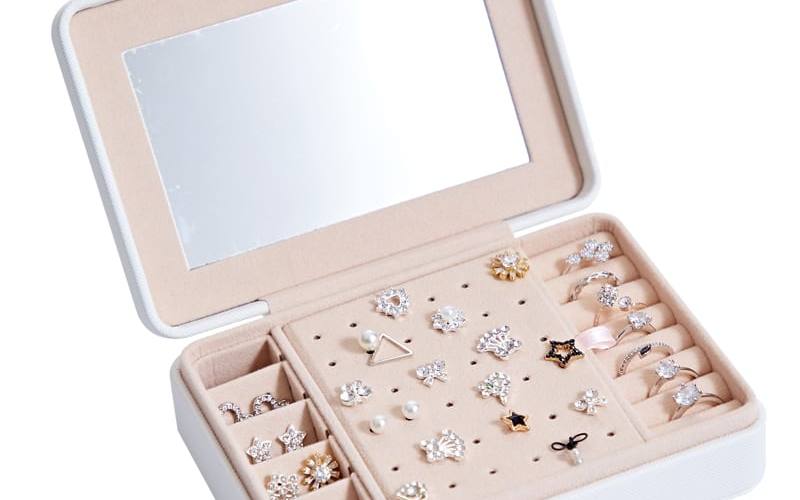
Ring rolls are padded rows with slots that hold rings upright. Each ring stays in place and stones do not knock against each other. A box for a ring collection should have at least one full row. A single ring, such as an engagement ring that is not worn every day, can also live in its own ring box.
Earrings
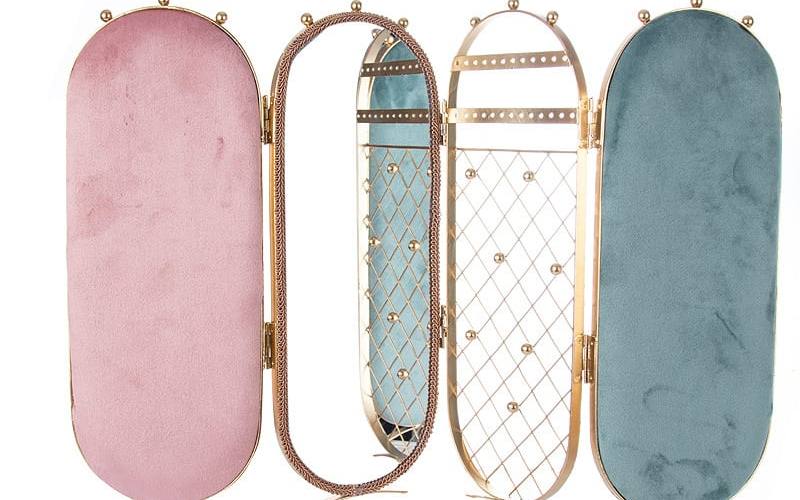
Studs are easiest to keep in pairs in a panel with holes or slits, or in a grid of small squares. Drops and hoops need a little more depth, or a bar to hang from. If you own many pairs, look for a dedicated earring panel or a separate earring organiser.
Necklaces and chains
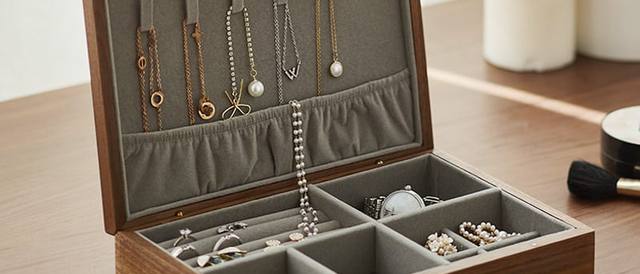
Chains tangle when they lie loose on top of each other. Look for hooks inside the lid, where a chain can hang straight, or long compartments where it can lie flat, one chain per section. Close the clasp before you put a chain away. Our guide on how to store jewellery has more ways to stop knots.
Bracelets, bangles and watches
These need the largest and deepest spaces. A watch is best kept on a small cushion, face up, so the glass cannot be scratched. If you own several watches, a separate watch box is often the better choice.
Removable trays and drawers
A removable top tray lets you lift out the pieces you wear most and reach the larger items underneath. Drawers keep layers separate so you do not have to unstack anything. Boxes with several layers, such as our large 4-layer jewellery box, let you give each type of jewellery its own layer.
3. Lining: soft, dense and easy to clean
The lining protects your jewellery from scratches on the box and on each other. Most jewellery boxes are lined with velvet, flannel or microfibre. What to look for:
- A dense pile that does not shed fibres onto your jewellery.
- A colour that suits you. Light linings make small studs and fine chains easier to spot. Dark linings hide dust and make-up marks for longer.
- Removable parts. Trays and ring rolls that lift out are much easier to clean. Our guide on how to clean a jewellery box lining goes through the steps.
A lining on its own does not stop silver tarnishing. For silver you do not wear often, add an anti-tarnish strip or keep it in a small sealed bag inside the box.
4. Lock or catch
Most jewellery boxes close with a magnetic or metal catch. Some have a small key lock.
A key lock helps when:
- children or visitors might open the box,
- the box stands in a shared space,
- you want the lid to stay shut if the box is knocked or carried.
A key lock does not:
- protect against a determined thief, as a small box can simply be carried away,
- replace insurance or a safe for valuable pieces.
If you choose a box with a lock, keep the key somewhere else, not in the box or taped to it. For watches, our ash wood 6-slot watch box closes with a small key lock.
5. Materials
- Wood and wood veneer. A wooden box looks like a piece of furniture. Veneer is a thin layer of real wood glued over a board such as MDF, which keeps the box stable and lighter than solid wood. Wood is natural, so grain and colour vary. Our walnut jewellery box is a wooden box with a grey lining.
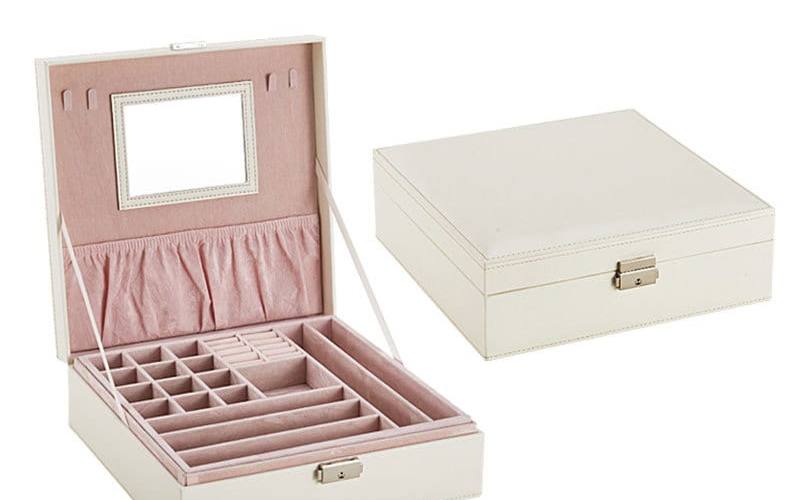
- PU leather. A man-made material with a leather-like coating. It is light, comes in many colours and wipes clean with a damp cloth. Our two-layer box with mirror and our three-layer box with handle are PU leather boxes.
- Glass. A glass lid shows your jewellery off, but it lets light in and needs to be kept out of direct sun, which can fade linings.
6. Mirror, handle and other details
- Mirror in the lid: useful for checking earrings and necklaces as you put them on, and handy in a box that travels.
- Carry handle: makes it easy to move the box from a wardrobe to a dressing table, or to take it on a trip.
- Lid stay: a ribbon or hinge that holds the lid open so it does not fall shut on your fingers.
- Feet or a soft base: stop the box scratching furniture.
Jewellery boxes for women and for girls
There is no special rule for a "women's" jewellery box: it comes down to the collection and the style of the room. Larger collections with long necklaces suit a box with lid hooks and several layers. Minimal collections suit a slim wooden box.
For girls, think about ease of use and safety:
- a small or medium box that a child can carry,
- a mirror and a simple layout with a ring roll and a few compartments,
- no glass lid for young children,
- keys and small parts kept away from young children.
Checklist before you order
- Count your pieces by type and add a quarter for growth.
- Check that the compartments match: ring rolls, earring slots, necklace hooks or long sections, deep sections for bangles.
- Check the outside size against the space you have, with the lid open.
- Choose a lining colour and check whether trays lift out.
- Decide whether you need a key lock.
- Choose the material: wood, wood veneer or PU leather.
- Look for a mirror and a handle if you will move the box around.
Every product page in our jewellery boxes range lists the supplier's measurements and materials. If something you need to know is not listed, email us before you order and we will check it for you.
Frequently asked questions
What size jewellery box do I need?
Lay out everything you want to store and count rings, pairs of earrings, necklaces, bracelets and watches. Then match them to compartments: ring rolls for rings, small squares or holes for earrings, hooks or long sections for necklaces and deeper sections for bangles and watches. Leave a quarter of the space free for new pieces.
What is the best lining for a jewellery box?
A soft, dense fabric such as velvet, flannel or microfibre. It cushions pieces and stops them scratching on the box. Darker linings hide dust and marks, lighter linings make small pieces easier to see. Removable trays make cleaning easier.
Do I need a jewellery box with a lock?
A lock is useful if children are around or if the box stands in a shared room, and it stops the lid opening if the box is knocked over. A small key lock is a deterrent, not a safe, so keep valuable pieces insured and keep the key away from the box.
Is PU leather the same as leather?
No. PU leather is a man-made material: a fabric base with a polyurethane coating that looks like leather. It is lighter, easy to wipe clean and usually cheaper than real leather. Our product pages say clearly which material each box is made of.
What is a good jewellery box for a girl?
A small or medium box with a mirror, a carry handle and simple compartments is easy for a child to use and keep tidy. Avoid boxes with glass lids for young children, and keep keys and small parts out of their reach.