Care
How to store jewellery so it does not tarnish or tangle
Why silver tarnishes, what speeds it up, how to keep chains from knotting and how to store pearls, gold and gems, with advice from GIA and conservators.
Most jewellery that looks tired has not been worn out. It has been stored badly: silver left in the open turns grey, chains knot into a ball at the bottom of a drawer, and stones scratch each other in a dish on the dressing table. Good storage takes very little effort once it is set up. This guide explains what causes tarnish, what to keep away from your pieces, and how to store chains, earrings, rings, pearls and watches so they are ready to wear.
What tarnish actually is
Tarnish on silver is not dirt. According to the Canadian Conservation Institute (CCI), the government body that advises museums on caring for their collections, the dark film is mainly silver sulphide. It forms when sulphur-containing gases in the air, above all hydrogen sulphide, react with the surface of the metal.
You cannot remove those gases from the air in a home, but you can slow the reaction a great deal. Three things matter most:
- How much air reaches the piece. A piece in a closed box or a sealed bag sees far less of the gas than a piece on an open dish.
- Humidity. The CCI notes that silver tarnishes faster as the relative humidity rises, and recommends keeping silver below 50% relative humidity. A steamy bathroom is the worst place in the house for a jewellery box.
- Nearby sources of sulphur. The CCI lists wool and wool felt, some paints, certain foods such as eggs, and vulcanised rubber, including rubber bands, among the sources of tarnishing gases.
Sterling silver is 92.5% silver (the 925 mark in a UK hallmark), and the rest is usually copper, which also darkens with time. Gold itself does not tarnish, but lower carat gold contains a larger share of other metals. 9 carat gold, marked 375, is only 37.5% gold, so 9 carat pieces can dull in the same conditions that tarnish silver.
Where to keep your jewellery box
Pick a dry room with a fairly even temperature. A bedroom chest of drawers or a wardrobe shelf works well. Avoid:
- The bathroom. Steam from baths and showers raises the humidity every day.
- Windowsills and radiators. Sun and heat dry out and fade linings and leather, and the temperature swings encourage condensation. GIA also advises against storing pearls in hot, dry places.
- The kitchen. Cooking adds moisture to the air, and some foods give off sulphur gases.
Keep the lid closed when you are not choosing something to wear. A closed box keeps out dust as well as air.
Materials to keep away from silver
Look at what your silver touches every day, not just where it is stored.
- Rubber bands. They are a common way to bundle chains or keep a ring box shut, and they are one of the sources of sulphur that the CCI names. Use a ribbon or a soft pouch instead.
- Wool and felt. Avoid storing silver directly on wool felt pads or wrapped in a wool scarf. If you do not know what the lining of an old box is made of, wrap your best silver in an anti-tarnish cloth or a small sealed bag inside the box.
- Cosmetics and perfume. GIA lists hairspray, perfume, cosmetics and even perspiration among the things that harm pearls. Put jewellery on after make-up and perfume, and take it off before you wash your hands or cream your skin.
How to slow tarnish down
The CCI advises preventing tarnish rather than removing it again and again, because every polish takes away some of the silver along with the tarnish, and polishes leave fine scratches. For jewellery at home, that translates into a few simple habits:
- Wipe pieces before you put them away. Skin oils and salts can mark silver and leave fingerprints. A soft, dry cotton cloth is enough.
- Store silver closed in. A lidded box is better than an open tray. For pieces you rarely wear, a small zip bag made of polyethylene, with the air pressed out, gives extra protection. The CCI uses sealed polyethylene bags for silver in museum stores.
- Use anti-tarnish cloth or strips. Silver cloth works because the tarnishing gases react with the silver in the cloth before they reach your jewellery. Strips and cloths get used up over time, so replace them when the manufacturer says to.
- Add a sachet of silica gel. Silica gel absorbs moisture inside a closed box. The CCI uses silica gel and activated charcoal together inside sealed bags.
If a piece has already darkened, see a jeweller for anything valuable, set with stones or plated. Plated jewellery in particular has only a thin layer of precious metal on top, and harsh polishing can wear through it.
How to stop chains and necklaces tangling
Chains tangle when they lie loose on top of each other and get moved around. The fix is to give each chain its own straight path.
- Fasten the clasp first. A closed chain can only twist around itself, not thread through others.
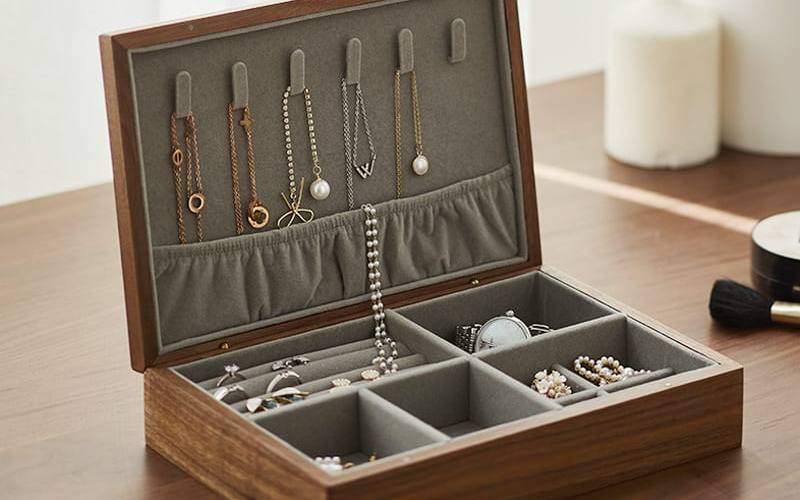
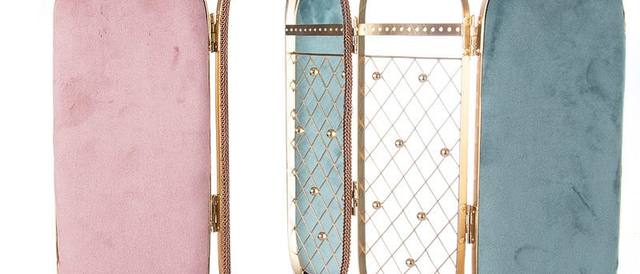
- Hang longer necklaces. Necklace hooks inside a jewellery box lid, or a stand with arms, keep chains hanging straight.
- Lay fine chains out flat. A long compartment or a drawer lined with fabric holds one chain per section. Do not pile several chains into one slot.
- Store pendants so they do not swing. A heavy pendant on a fine chain pulls the chain into knots when the box is moved. Lay the pendant flat, or hang it so it rests against the back of the box.
- For travel, use a straw or card. Thread a fine chain through a drinking straw and close the clasp outside it, or wrap it around a folded piece of card. A travel case with snap straps does the same job. Our guide to travel jewellery cases covers this in more detail.
Earrings, rings and bracelets
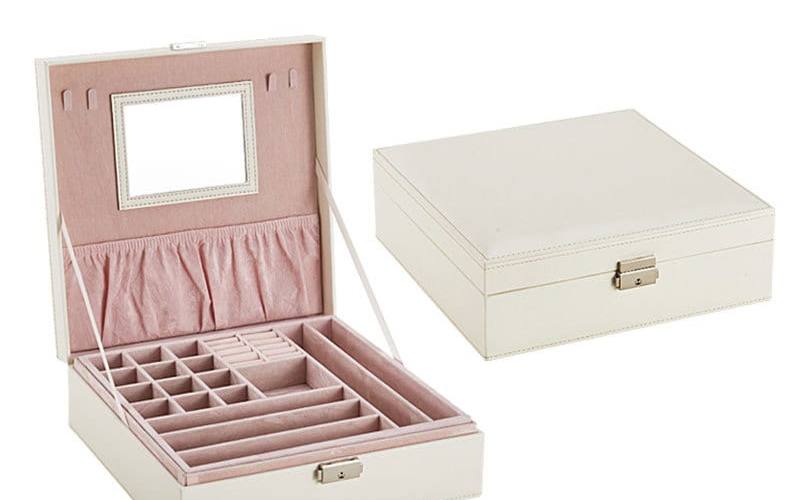
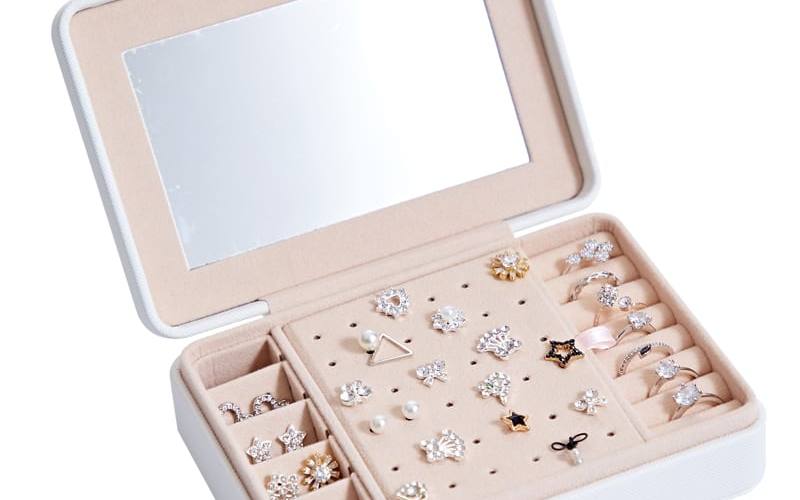
- Earrings: keep pairs together. Grid compartments, earring holes in a padded insert or a stand with holes keep studs paired and stop the posts bending. Put the backs on the posts before storing.
- Rings: ring rolls, the padded rows that rings slot into, hold each ring upright and apart, so stones do not knock against each other. GIA notes that diamonds can scratch other gems, so give a diamond ring its own slot.
- Bracelets and bangles: lay them flat in a larger compartment. Chain bracelets follow the same rules as necklaces.
Pearls need different treatment
Pearls are much softer than other gems. GIA puts pearl at 2.5 on the Mohs hardness scale, which means they scratch easily. Its advice is to:
- wipe pearls with a very soft, clean cloth after each wear,
- store them in a soft pouch or case, away from sharp or rough objects,
- keep them away from harsh chemicals such as perfume, hairspray and cleaning products,
- avoid storing them somewhere hot and dry.
Because a sealed polyethylene bag suits silver but not pearls, keep the two apart: pearls in a soft pouch in their own compartment, silver in its sealed bag or wrapped in anti-tarnish cloth. GIA also notes that strung pearls may need restringing from time to time, as the silk thread can darken, stretch or wear thin.
Watches
Store watches face up on a cushion or in a padded slot so that the glass cannot be scratched by other pieces. Keep leather straps out of sunlight and away from radiators so they do not dry out or fade. If you own more than two or three watches, a dedicated watch box is easier than squeezing them in with your jewellery. Our watch box buying guide explains slot sizes and cushions.
Setting up your jewellery box
A good setup takes about half an hour:
- Sort everything into what you wear every week, what you wear now and then, and what you keep for its value or memories.
- Give everyday pieces the easiest-to-reach compartments: the top tray of a jewellery box or a dish-style organiser on the dressing table.
- Wrap or bag silver you rarely wear, add an anti-tarnish strip or a silica gel sachet, and put it in a lower drawer.
- Give pearls a soft pouch of their own.
- Hang or lay out every chain on its own, with the clasp closed.
Once that is done, the daily routine is short: wipe, put back in its place, close the lid. Our guide on how to choose a jewellery box helps you find a box with the right mix of compartments, and how to clean a jewellery box lining keeps the inside fresh.
Frequently asked questions
Why does my silver jewellery go black?
The dark film is tarnish, mostly silver sulphide. It forms when sulphur gases in the air, such as hydrogen sulphide, react with the silver. It forms faster in damp air and near sources of sulphur such as wool, felt and rubber bands. Storing silver dry and sealed slows it down a lot.
Do anti-tarnish strips and cloths work?
They slow tarnish down. Anti-tarnish cloth contains fine silver particles or chemicals that react with the tarnishing gases before they reach your jewellery. They work best in a closed box or bag and need replacing from time to time, as the active part gets used up.
Can I keep all my jewellery together in one box?
Yes, as long as each piece has its own space. Hard stones such as diamonds can scratch softer gems and metal, and pearls scratch easily. Use separate compartments, ring slots or small soft pouches inside the box.
How do I stop necklaces tangling?
Close the clasp before you put a chain away, then hang it or lay it out straight in a long compartment, one chain per slot. For travel, thread fine chains through a drinking straw or wrap them around a folded piece of card.
Should I store pearls in a plastic bag?
No. The Gemological Institute of America (GIA) advises storing pearls in a soft pouch or case, away from hard or sharp objects, and wiping them with a soft cloth after each wear.