Watch boxes
Watch box buying guide: slots, cushions and window lids
How many slots you need, how to check that your watches fit the slots and cushions, glass lids and sunlight, locks, materials and watch rolls for travel.
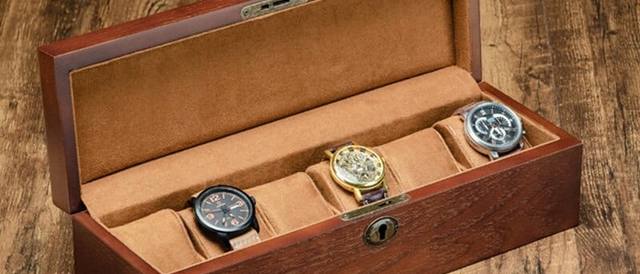
A watch box keeps your watches apart so they cannot scratch each other, holds them in shape on a cushion and keeps the dust off. It also turns a drawer full of loose watches into a small collection you can see at a glance. Watch boxes look similar online, but slot sizes, cushions and lids differ more than the photos suggest. This guide explains what to check before you buy.
1. Number of slots
Start with the number of watches you own, then add room to grow. Most collections grow by a watch or two over a few years, and spare slots are handy for a bracelet, a pair of cufflinks or a spare strap.
| Your collection | Slots to look for | Typical format |
|---|---|---|
| 1 to 3 watches | 3 | travel roll or small case |
| 3 to 5 watches | 5 or 6 | single row box |
| 6 to 10 watches | 10 or 12 | double row box |
| more than 10 | 12 or more, or two boxes | large double row or two layers |
Think about where the box will live, too. A 12-slot box is roughly the size of a large book lying flat, so measure the space on your chest of drawers or the shelf in your wardrobe before you order.
2. Slot size and cushion
Every slot holds one watch wrapped around a soft cushion, sometimes called a pillow. Three measurements decide whether your watch fits:
- Slot width. Measure the case diameter of your largest watch and add the crown, which sticks out on the side. Compare that with the inside width of a slot. Our product pages list the inside size where the supplier gives it, for example about 5.5 cm per slot in our ash wood 6-slot watch box.
- Height under the lid. A thick watch on a cushion needs space before the lid closes. This matters most for divers, chronographs and smartwatches with tall cases. A box with a deep lid or a domed window has more room.
- Cushion size. The strap or bracelet goes around the cushion. A bracelet sized for a small wrist may not close around a full-size cushion. Open the clasp and lay the watch on the cushion instead of forcing the bracelet over it.
If you are not sure, measure the inside of the closed strap or bracelet with a tape measure, from the case around to the case, and compare it with the cushion. Cushions on most boxes are soft and squeeze a little, so you have some leeway.
Tip: Removable cushions are useful. You can take a watch out on its cushion, and you can use an empty slot for something else, such as cufflinks or a ring.
3. Window lid or solid lid
A glass or clear window in the lid lets you see your watches without opening the box. It shows a collection off on a dressing table or a shelf, and you can pick a watch for the day at a glance.
There is one thing to watch out for: sunlight. Direct sun through the glass can fade leather straps and some dial colours over time and warm up the inside of the box. If your box has a window, keep it out of direct sunlight. A solid lid needs no such care and suits a box that lives inside a wardrobe or drawer.
4. Materials
- Wood. A solid wood or wood veneer box is heavier and looks like furniture. Wood is natural, so the grain and colour vary from box to box.
- PU leather. PU leather is a man-made material with a coated surface that looks like leather. It is lighter, easier to wipe clean and usually less expensive than real leather. Our product pages say clearly whether a box is PU or real leather.
- Lining. Velvet, suede-effect and microfibre linings protect cases and glass. Light linings show dust and marks sooner, dark linings hide them.
To clean the inside, see our guide on how to clean a jewellery box lining. The same steps work for watch box cushions.
5. Lock or latch
Many watch boxes close with a simple metal latch. Some have a small key lock. A key lock keeps children and curious visitors out and stops the lid from opening if the box is knocked over, but it is not a safe. Keep valuable watches insured, and store the key away from the box.
6. Watches and magnets
Mechanical watches, both automatic and hand-wound, can be affected by strong magnets. A magnetised movement can gain or lose time until a watchmaker demagnetises it, which is a quick job. The international standard for antimagnetic watches, ISO 764, requires a watch sold as antimagnetic to keep within 30 seconds a day after exposure to a magnetic field of 4,800 A/m, and many watches are not rated at all.
So keep your watch box away from strong magnets: loudspeakers, magnetic phone mounts and stands, and bags with magnetic clasps. Some watch boxes and rolls close with a magnet. Our product pages say so where the supplier lists a magnetic closure.
7. Automatic watches in a box
A watch box stores watches; it does not wind them. An automatic watch stops once its power reserve runs out, often after a day or two in the box. That is normal. Before you wear it again, wind it a few turns with the crown if your movement allows hand winding, then set the time and date, following the maker's instructions. Keeping automatic watches running all the time needs a watch winder, which is a powered device and a different product from a storage box.
8. Travel: watch rolls and small cases
A box is for home. For travel, a watch roll or a small zip case is easier to pack. A roll holds one to three watches on cushions inside a firm tube, so they cannot knock together in a bag. Pack it in your hand luggage, not in a checked suitcase. Our guide to travel jewellery cases explains why.
A quick checklist
Before you order a watch box, check:
- the number of slots, with two or three spare,
- the slot width against your largest watch, crown included,
- the height under the lid for your thickest watch,
- whether the cushions are removable,
- window lid or solid lid, and where the box will stand,
- latch or key lock,
- the outside size against the space you have.
All our watch boxes list the number of slots, the materials and the size the supplier gives on the product page. If something is missing that you need to know, email us before you order and we will check it with our supplier.
Frequently asked questions
How many slots should a watch box have?
Count the watches you own today and add two or three. Most people buy more watches over time, and a box with spare slots also holds a bracelet, cufflinks or a spare strap. A 3 to 6 slot box suits a small collection, 10 to 12 slots a growing one.
Will a large watch fit in a watch box?
Check two sizes on the product page: the width of each slot and the height inside the box with the lid closed. The case diameter plus the crown must fit the slot width, and the thickness of the watch on its cushion must fit under the lid. Chunky dive watches and chronographs are the ones to measure.
Do watch cushions fit small wrists?
A bracelet or strap that is sized for a small wrist may be too tight to close around a standard cushion. Open the clasp or buckle, lay the strap around the cushion and close it on a looser hole, or leave the clasp open. Do not force a bracelet over a cushion, as it strains the clasp.
Does a watch box keep an automatic watch running?
No. A watch box only stores the watch. An automatic watch stops once its power reserve runs out, often after a day or two. Before you wear it again, wind it with the crown if the movement allows and set the time. Keeping watches running needs a watch winder, which is a separate, powered device.
Is a glass lid bad for my watches?
Not in itself, but direct sunlight through the glass can fade leather straps and some dial colours over time and warm up the inside of the box. Keep a box with a window lid out of direct sun, for example on a shelf away from the window or inside a wardrobe.